
Although we use them every day, most people do not think too much about the font collection , but mostly rely on a few basic ones. Content is more important than form. But is it really like that in marketing? By carefully choosing, and especially by creating a new font, we are given the opportunity to give the text a recognizable identity. Something like a handwritten signature. In this text, we will try to give some tips that you should take into account if you decide to create a new font, that is, typography.
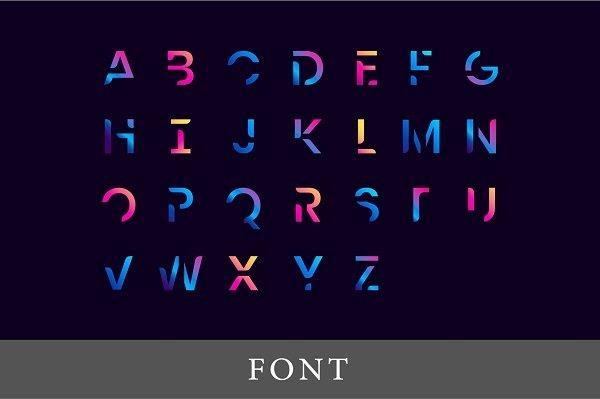
To be clear right away, the fact is that creating the entire alphabet, uppercase and lowercase letters, punctuation marks, spacing between lines and letters, can be a time-consuming process. If we add to that different styles such as regular, italic and bold, then it is definitely recommended that you limit the creation of typography to the logo, slogan or name on the product packaging, and for longer texts, website or mobile application, use some of the already existing fonts on the Internet.
However, if you still want to create an entire font, you need to know the entire process, from the sketch, to creating the shape of the letter, to converting the drawing into a font file that you can later use within software such as Microsoft Office and Adobe Creative Cloud .
In order to better understand the entire process of creating letters, we need to distinguish several basic terms:
- Typography – The art of arranging and styling.
- Typeface – Unique design of letters in the alphabet.
- Font – A software file that contains a specific font.
- Calligraphy – Skillful handwriting with ornaments.
- Handwriting – Illustrative display of handwriting.
We also distinguish between the two basic types of font formats OTF and TTF.
TTF was developed by Apple and Microsoft in the 80s to make fonts easily read by computers and printers, while OTF was later developed by Microsoft and Adobe to extend these features.
Basics of font design
In order to get to drawing and creating letters, we need to clarify the construction of letters, that is, letters.

So, to begin with, you should pay attention to the guidelines, we will more often use the English term guidelines and the anatomy of letters.
As most elements and tools in graphic design rely on basic shapes, typography is no exception. Letters can be grouped into specific categories based on their shape. So we distinguish straight, curved and triangular letters.
Straight letters are for example D, M or N, then example of curvilinear letters are S, O or G, while triangular letters are for example A and V. Of course, this is not such a strict rule because letters can belong to any group and even a combination of two or all three groups depending on your design.
Also a not so strict rule, but it is certainly desirable to apply it due to the legibility of the font, is the alternation of thick and thin lines while drawing letters. In this way, the letter or typeface looks as if it was written with a pen – calligraphic. The relationship between thick and thin lines has a lot to do with the look and style of the font.
What is certainly a rule that should be taken into account is that the distance between the letters should not always be the same, because depending on the shape, they can create an optical illusion. So for example the space between V and A is not the same as for example between O and C, but you have to adjust it so that the words and sentences look harmonious. Similarly, curvilinear letters must be a shade larger than straight letters.
Objectives
We return to the advice from the beginning of the text that if you want to create a new font and not use one of the existing ones, you should have a clearly defined goal. Some of the following questions that you should ask yourself or the client you work for will help you with this.
Why?
For example, if you want to emphasize brand recognition or if you are creating a product line.
For whom?
If you work for a specific brand, you should have information about the needs of the business, that is, about the target group. If, on the other hand, you are designing a font to put on the web for general purpose, then you should create your own target audience that will be attracted to the style, as well as potential projects that your font would be suitable for.
With what purpose?
The font you create should have a clear purpose. The concept should be differentiated if the font will be used for brochures and catalogs, for a line of cosmetic products or for a new video game.

In any case, you should have a clear plan of why your font will be different from others and what will make it special and unique.
Every creation process starts with a sketch. Depending on how much time you have, try to sketch as many variations of reference characters as possible and apply them in the text. You can rely on the graphic solutions of some of the existing fonts using certain elements, so you do not copy them but build on them. You don’t have to create an entire font right away, it’s important to research and set basic principles that you’ll stick to as you create each subsequent character.
After completing all the previous steps it is up to you to create and draw the characters step by step using some of the vector graphics programs.
For more news and interesting stories from digital marketing, visit our blog page or follow our Instagram profile.
Made by Sava Spasić – Senior Graphic Designer @Digitizer
Pročitaj:


