

Do you know how to write advertising copy that will attract a huge number of customers? And you don’t have to have a great talent for writing. The answer is AIDA!
AIDA is one of the most famous marketing models. This model is based on the cognitive stages that an individual goes through in the process of making a decision to purchase a product or service. Effective performance is often crucial to the success of your digital marketing.
How did AIDA come about?
For that, perhaps it is best to look at Verdi’s biography. This famous composer composed many famous compositions, of which Aida is perhaps the most famous. However, the similarity with our AIDA is that Verdi’s also has 4 acts. As well as the AIDA we are talking about.
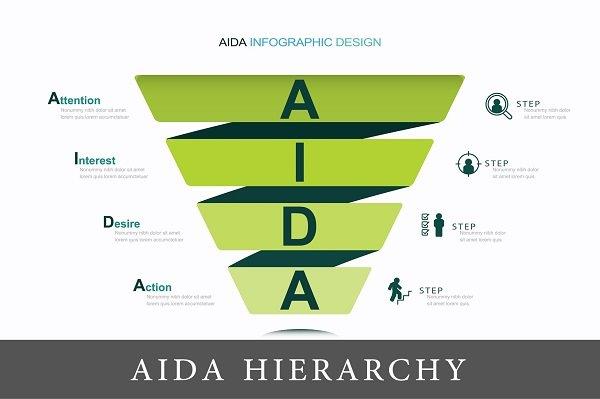
AIDA stands for:
- A TTENTION (attention) – drawing attention to a specific product
- I NTEREST (interest) – arousing the customer’s interest in a certain product or service, so that he begins to investigate further and inquire about a certain product
- D DESIRE (desire) – causing the customer to want to have that product
- A CTION (action) – inviting the customer to take the next step that leads to the purchase of a product or service.
Simply put, the AIDA model leads the customer to learn about a particular product, like that product, and eventually buy it.
How does AIDA work?
A – ATTENTION or AWARENESS
The first stage focuses on getting attention. The goal of this phase is to let as many people as possible know about a certain product. This is achieved through advertising, and advertising through all available media platforms, of course taking into account the cost of advertising. As social networks are a relatively new form of advertising, new methods of advertising are also being used, one of which is brand cooperation with influencers.

I – INTEREST
From the people who learned about the product in the first phase, a certain number of them stand out and are interested in it. They want to know more about that product, they want to know the details related to the product and how it can benefit them. Some of these details may be included in the ad itself, but more often it happens that individuals themselves want to know more about the product they are interested in, so for example they will search the Internet to see, say, the specifications of the mobile phone they are interested in.
D – DESIRE
From the number of people who have shown an interest in the product, a certain number of them who develop a desire to have that product stand out again. These people are potential clients. At this stage, they have a clear desire for a specific product or service. In addition to the desire, there are also certain “obstacles” for the customer at this stage (such as perhaps the high price of the product).
A – ACTION
Those who “overcome the obstacles” that exist to purchase a certain product take action and become customers or clients. There are techniques that “help” customers to decide on the last stage of the purchase, ie. to overcome obstacles. These techniques are based on behaviorism, that is, the psychology of the behavior of potential clients.

One of the ways to attract the attention of a potential customer is to place ads in unusual places. This is called “guerrilla marketing”. Also, there is a “shock” factor, that is, attracting attention using, for example, provocative photos.
Stimulating the desire for a certain product is done in different ways, and what is important is to show the potential customer why he needs that particular product. This is done by highlighting interesting facts about the product and showing its benefits, which makes the potential customer want the product even more.
Is the AIDA model good for everyone?
Some criticize the AIDA model saying that it is too simple and that the same method cannot be used to advertise different products (eg buying a car at a car dealership is not the same as buying sneakers online). That is why there are variations of the AIDA model, and some of them are:
- AIDCAS – the words CONVICTION (belief or conviction in the desire and need of a potential customer to have that particular product) and SATISFACTION (satisfaction with the purchase) were added here.
- NAITDASE – added the words NEED, TRUST, SATISFACTION and EVALUATION.
.
For more news and interesting stories from digital marketing, visit our blog page or follow our Instagram profile.
Made by Ana Korolija – Senior Copywriter @Digitizer
Pročitaj: