
We have already written about how the choice of colors and typography affects the consumer’s perception of your brand. However, did you know that the shapes you use in your visual identity are more than practical, constructive graphic elements because their meaning makes visual communication even easier for designers.
Psychology and the meaning of form in design
In this text, we will explain how, in theory, shapes can influence consumers.
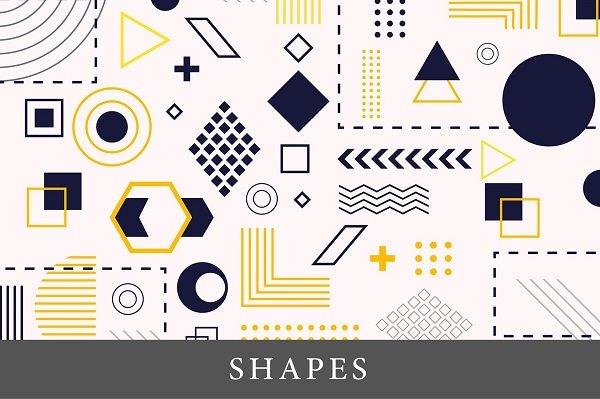
How important knowledge of shapes is, not only for designers but also for visual artists in general, is also shown by the fact that all learning begins with a simple drawing of shapes and their application. However, since there are infinite forms, i.e. just as many as human imagination can imagine, it is important to sort them first of all into simple and complex.
The basic group includes geometric bodies such as a square, rectangle, circle, ellipse and triangle, while the more complex ones include shapes obtained by modifying and combining basic shapes.
Another division, which is equally important and can significantly influence your design, is the shapes you can find in nature, such as for example the shape of leaves, waves or rocks and on the other hand those created by man, for example the shapes of buildings or machines .
The meaning of the form
Each form can have its own specific meaning and can have an associative effect on the consumer’s experience.

A square
Since formats in design are usually square or rectangular, graphic elements like this are the easiest to stack on top of each other, something like bricks and blocks in a building.
That is why it is not surprising that such elements are most often associated with stability. They are also very often associated with weight and immobility. As for the personality, these elements also symbolize reliability and strictness.
The most common associations for the square and rectangle: stability, constancy, reliability, strength, seriousness

Circle
Circles and ellipses, as opposed to squares and rectangles, primarily symbolize movement precisely because of the association with a wheel, ball or gears.
Since they do not have sharp edges, they are also used for “user friendly” design. Such graphic elements are almost invariably used in children’s designs because they are associated with joy.
However, circles and ellipses are given a “serious” touch by the fact that they have no beginning and end, so they can also be connected to cycles, such as time.
The most common associations for the circle and ellipse: movement, lightness, happiness, softness, innocence, infinity
A triangle
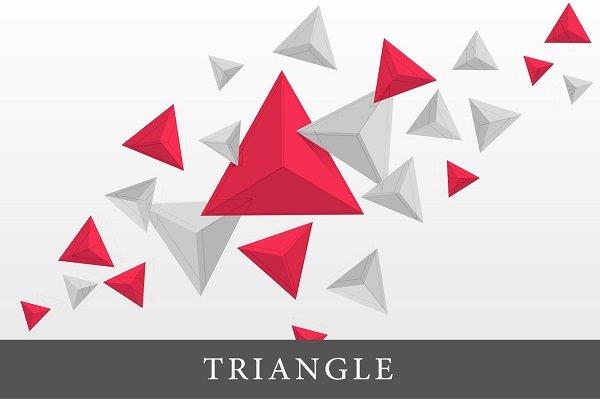
Perhaps the clearest association for triangles is sharpness. That is why they are often used in design to indicate danger, but what makes triangles recognizable are arrows, that is, elements that indicate the direction or elements that need to be accentuated.
The most common associations for the triangle: sharpness, danger, path, balance.
Although modern design tends more and more to minimalism and the use of as few and as simple shapes as possible, you will find yourself in a situation where you combine more than one element. In that case, clearly establish a visual hierarchy and separate which elements are “older” than others.
In order to avoid confusion, keep in mind that shape psychology functions as a subconscious. So consumers usually don’t look at shapes and literally think about how stable or dynamic your brand is. It’s more about subjective feeling. With this in mind, the use of forms should not be taken as a rule. As long as the graphic elements of your design even suggest something, they will convey information or emotions, which is the main goal.
For more news and interesting stories from digital marketing, visit our blog page or follow our Instagram profile.
Made by Sava Spasić – Senior Graphic Designer @Digitizer
Pročitaj:


